
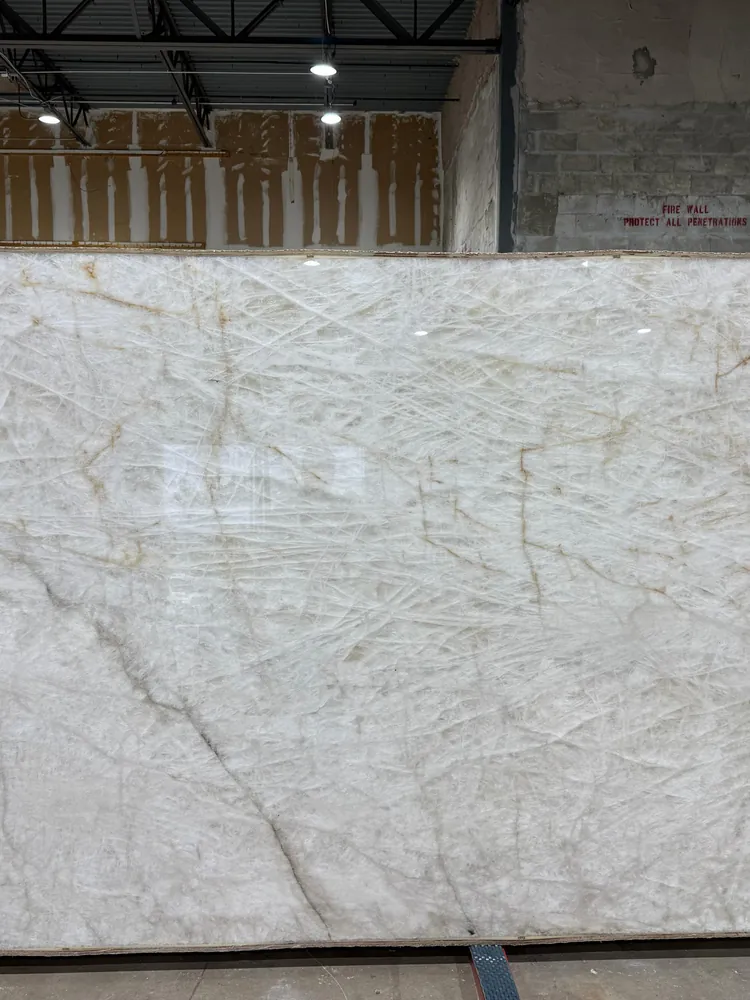
When you’re planning a kitchen or bath remodel, the first big decision is selecting the right slab. Having a large stock of stone slabs in Boynton Beach means you can walk through a warehouse and hand-pick your favorite piece. Whether you’re dreaming of granite slabs with dramatic veining or the clean look of quartz slabs, seeing them in person helps you find the perfect fit for your home.
You can get a head start online with our countertop slabs in stock, where every slab we have photographed is listed under the name of the stone. This guide covers how to choose a countertop slab once you’re standing in front of the real thing: the finish, the thickness and edge, the way the veining moves, where the seams will land and how many slabs your layout calls for.
Why the Full Slab Matters More Than a Sample
Showrooms with hundreds of granite, quartzite, marble and quartz slabs let you compare different cuts side by side, making it easier to match your design goals.
A sample is a few inches of stone. A full slab is closer to 120 by 55 inches, and across that much stone a natural slab can change: veins widen and wander, and the background can drift warmer or cooler from one end to the other. Every natural stone slab is one-of-a-kind, which is why we’d rather you stand in front of the very slab we’ll cut than hold a chip in your hand.
Quartz works differently. It is blended from natural quartz, resin and pigments, so two slabs of the same color read almost identically. If you want a pattern nobody else has, look at natural stone such as granite or quartzite.
Polished, Honed or Leathered
Shopping for stone slabs near Palm Beach County is about more than just color. Pay attention to finish (polished vs. honed) and edge profiles, which play a big role in the final look of your countertops.
The finish is the texture given to the surface of the slab, and it changes how the same stone looks and feels:
| Polished | Honed | Leathered | |
|---|---|---|---|
| Surface | Glassy and smooth | Smooth and matte | Textured, with a soft sheen |
| Light | Reflects it | Little to no reflection | A low, satiny glow |
| Color and veining | At their deepest and sharpest | Softer and slightly lighter | Rich, with a natural feel |
Many homeowners are surprised by how much a honed marble slab or a leathered granite slab can change the personality of a kitchen island. Finishes are not offered across every stone and color, so ask which ones you can get on the slab you like. With quartz, the finish is sometimes part of the color name: Olympus Honed and Pure White Brushed are two of the quartz colors we carry.
Thickness and Edge Choices
Ask about slab thickness, too; a 3 cm slab offers durability and is ideal for busy kitchens. We work in 2 cm and 3 cm.
The edge profile is the shape of the countertop’s exposed edge, the part you see and touch every day. A straight polished edge is our standard. Beyond that, we cut eased, beveled, ogee and mitered edges, and an island can end in a waterfall, where the stone turns the corner and runs down to the floor. A mitered edge adds a second strip of stone under the front, cut at 45 degrees, so the counter reads thicker than the slab it came from.
- Straight
- Eased
- Beveled
- Ogee
- Mitered
- Thickness
- 2 cm and 3 cm
- Edges
- Straight polished as standard
- Islands
- Waterfall ends
- Finish
- Depends on the slab
Veining, Movement and Where the Seams Fall
Veining is the pattern of lines running through a stone, and movement describes how boldly, and in which direction, that pattern flows. On a slab with strong, directional veins, the part a piece is cut from matters: an island top, a waterfall end and a backsplash can each show a very different stretch of the same slab.
Because a slab is only about 120 inches long, a long countertop run or a big island may not fit in one piece, and that is where seams come in. We plan the layout on your actual slab so the veining flows across each joint, keep the number of joints down to what your layout really needs, and place them out of your main sight line, often beside a sink cutout or a break in the cabinets. You see where every seam falls before we cut. Our page on slab layout and seam planning shows how that step works in the shop.
How Many Slabs Your Kitchen Needs
There is no fixed number; it comes down to your layout. These are the things that add stone:
- Long runs and large islands, since every piece has to fit within a slab of about 120 by 55 inches
- Backsplash height, since a full-height backsplash takes far more stone than a 4-inch one, and both come from the counter’s own material
- Waterfall ends, where the stone continues down the side of an island
- Vein matching, when two pieces need to line up across a seam
- Backsplash
- Sink and faucet cutouts
- Planned seam
- Island
We price by the square foot. For a slab already in our own stock, what you pay covers the area your project uses, not everything standing on the rack. Material ordered in from a supplier works differently — a few colors only ship as whole slabs, and we flag that while your estimate is being put together.
The quickest route to a count is a picture of the kitchen and a few rough measurements (a hand-drawn sketch works). No tape measure handy? We’ll measure for free.
Walking a Slab Showroom
Whether you’re walking a showroom or a slab yard, a visit goes faster with a plan. Four habits help:
- Step back before you step in. Look at the whole slab from a few feet away, then up close at the veins and the surface.
- Carry a piece of the room with you: one cabinet door, a spare floor tile or a swatch of your wall paint. The design consultation is free, whether we meet at the showroom or at your house.
- Ask about the finish and the thickness for that particular slab, not just the color.
- Take a photo of the slab you like, so you can tell us exactly which one it is.
Finally, remember that slab inventory changes as slabs go into projects. Natural stone never repeats, so the granite, quartzite or marble slab you fall for is the only one with that exact pattern. Once you’ve found it, let us know which slab it is and schedule your project.
A deep inventory only helps you if you can see into it, so the slabs we have photographed are published one at a time. Our slabs in stock page gives each one its material, its thickness, its finish and a slab number, under the name the stone actually carries — so “Slab AC-04, Cristallo quartzite” is enough for us to know the exact piece you mean. Bring that number to the conversation and we’ll confirm it is still in our stock before you make the trip.
Ready to see our selection for yourself? You can visit our showroom in Boynton Beach, at 2114 Corporate Dr, to browse our slabs in person, or call us at (561) 200-5555 to schedule a free consultation. The showroom sits near the Woolbright Road exit of I-95, about a minute from Lowe’s. We’ll help you find the stone that makes your dream kitchen or bath a reality!