
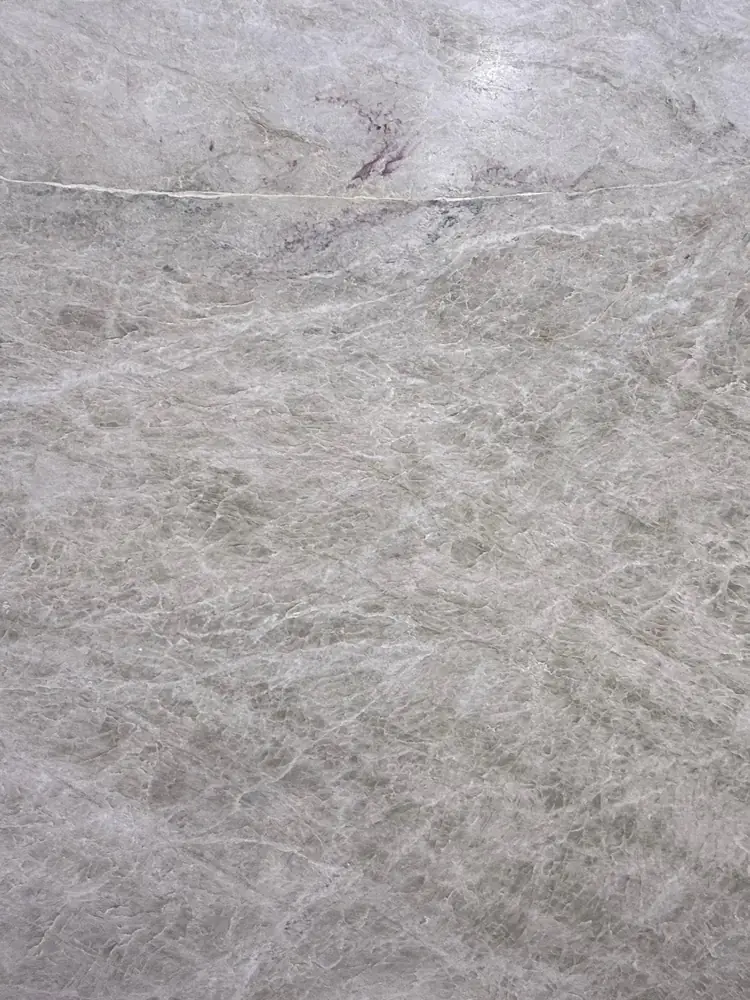
If you've ever wondered how a slab of stone turns into a polished kitchen island, you're not alone. Custom countertop fabrication is a craft that blends technology and artistry.
Here is how countertop fabrication works, in five steps: templating, laying out the cuts, cutting, edges and polishing, then the cutouts. Below we walk through each step of the countertop fabrication process and the decisions that are yours along the way. Shopping for a fabricator rather than an explainer? Our page on countertop fabrication in Boynton Beach covers the work we do in our own shop.
Step 1: Templating Your Cabinets
It starts with templating. After you've selected your slab, the installers who will set your countertops come to your home for digital templating and make a precise template of your cabinets and walls. That template is what makes your granite or quartz countertop fit around sinks, cooktops and corners.
A countertop template is a full-size pattern of every piece, laid out right on top of the cabinets. Walls are rarely straight and corners rarely square, and a pattern made in place records those differences.
For that to work, your kitchen needs to be template-ready: cabinets installed, and anything that goes on top of or under the counter already in place.
Step 2: Laying Out the Cuts on the Slab
Next, the template meets the stone. A standard slab is only about 120 by 55 inches. On a long wall or a big island, that often means two pieces joined at a seam. Laying out the cuts means deciding where every piece will come from on the slab before a single cut is made.
Your layout is planned on the actual slab you chose, not on a sample. The aim is as few seams as your kitchen allows, set where the eye doesn't land first, such as beside the sink opening or at a break in the cabinets, with the veining running the same way across each joint. You'll know where each seam falls before anything is cut.
- Countertop run
- Sink and faucet cutouts
- Return
- Seam edges
- Backsplash strips
- Offcut
That is also why the slab itself matters so much. Because we keep 500+ slabs in stock, you can pick out the exact slab for your kitchen instead of judging from a small sample.
Step 3: Cutting
Templates are then used in our shop to program the CNC equipment that cuts your countertop. Cutting and polishing both happen in-house, at our Boynton Beach shop, and no piece goes out to another fabricator.
CNC stands for computer numerical control: the machine follows a programmed path instead of a hand-guided line, which is how granite countertops are made in our shop, one piece at a time.
Your countertop is cut from a 2 cm or 3 cm slab. For busy kitchens, 3 cm is a popular choice, and the two thicknesses are priced differently.
Step 4: Edge Profiles and Polishing
During countertop fabrication, the edges are finished to your chosen profile, and surfaces are polished to enhance the stone's natural beauty. Straight polished is the standard edge. Beyond it, you can choose eased, beveled, ogee or mitered profiles, and waterfall ends that carry an island's top down to the floor.
- Straight
- Eased
- Beveled
- Ogee
- Mitered
If you're investing in quartzite or marble countertops, ask about edge treatments that show off the stone's veining. A mitered edge, for instance, adds a strip cut from the same slab at the front, so the pattern turns the corner with the edge. For custom quartz countertops, many homeowners choose a sleek straight edge for a modern look.
The face of the stone gets a finish of its own. Polished is glossy and reflective, honed is matte, and leathered and brushed finishes have a texture you can feel. Finishes vary by material and by color, so ask which ones your slab comes in.
Step 5: Cutouts for Sinks, Cooktops and Faucets
Openings are part of fabrication, too. Your sink opening, the cooktop cutout and each faucet hole are all made in our shop, so the stone arrives at your home ready to set. The cutouts are listed on your estimate, too.
Not every opening is a neat rectangle. Where the counter meets a pipe chase or an out-of-square wall, the template is cut to fit around it, and the stone gets the same shape in the shop.
The sink you choose sets the size of its opening, so settle on the model early; our sinks page compares the styles we work with.
Planning a seating overhang on a breakfast bar or kitchen island? Mention it before templating, so the overhang is part of the layout from the start.
Why a Local Shop Matters
Choosing a local shop for countertop manufacturing near Boynton Beach offers several advantages. Our showroom and our fabrication shop share one address, so the slab you choose doesn't travel far before it's cut.
The people who measure your kitchen for the template are the same crew who return to install the stone. Installation day typically arrives 7–10 business days after templating, and most kitchens are installed in a single day. Our guide on what to expect on installation day explains how to get ready, and our page on countertop installation covers the rest.
A local fabricator also knows what South Florida asks of stone. Planning an outdoor kitchen? Granite and quartzite are the two stones we recommend there, since both handle heat and sun. Quartz belongs indoors, because sunlight can discolor its resin.
Whether you're updating a vanity with marble countertops or installing quartz countertops in a Boca Raton condo, you work with one local team from templating to installation. Want to see the slabs before you decide? You can visit the showroom in Boynton Beach, where the design consultation is free, or call (561) 200-5555. Our team is ready to answer your questions.