
When homeowners start planning a kitchen renovation, one of the most common questions is:
Should I choose quartz or granite countertops?
Both materials are extremely popular in Florida kitchens, and each offers unique advantages depending on your lifestyle, design goals, and budget.
At American Countertops & Design in Boynton Beach, we help homeowners compare the two materials. Let’s break down the differences.
Quartz vs granite countertops is the call most kitchen plans come down to. Here is how quartz and granite countertops differ where it counts: heat, spills, sealing, outdoor use and looks.
Quartz at a Glance
Quartz countertops are engineered stone surfaces made from natural quartz mixed with resins.
They are extremely popular in modern kitchen designs because they offer:
- Consistent colors and patterns
- High stain resistance
- No sealing required
- Easy maintenance
Quartz is ideal for busy kitchens where homeowners want a beautiful countertop that requires very little upkeep.
The resin that keeps quartz so easy to live with also sets its two limits: hot cookware belongs on a trivet, and the surface belongs indoors, out of direct sun.
Granite at a Glance
Granite countertops are 100% natural stone, cut directly from slabs quarried around the world.
Every slab is unique. That means your kitchen will have a one-of-a-kind surface with natural movement and depth.
Granite is known for:
- Exceptional durability
- Heat resistance
- Natural stone character
- Long lifespan
Many homeowners still prefer granite because it brings natural elegance and timeless value to a home.
Granite is also semi-porous, which is why it gets sealed, and why we recommend resealing it every 1–2 years.
Heat, Scratches and Stains
Heat is where the two part ways. Granite handles heat well, which makes it the more forgiving surface next to the stove. Quartz contains resin, so we recommend a trivet or hot pad under hot pots, pans and baking sheets.
Stains favor quartz: its non-porous surface gives spills nothing to sink into. Granite is semi-porous, and the sealer is what keeps spills out, so wipe up oil, wine and coffee before they sit.
For scratches, granite is a hard natural stone that stands up well to daily use, and quartz is a durable surface too. On either one, a cutting board protects the finish and your knives.
Sealing and Maintenance
Quartz never needs sealing at any point in its life. Day to day, a soft cloth and a mild cleaner keep it looking new.
Granite asks for a bit more. We recommend a penetrating sealer every 1–2 years, and a pH-neutral cleaner made for stone for everyday wiping. A quick check tells you when it’s time: if water beads up on the surface, the sealer is still doing its job; if it soaks in and darkens the slab, book a reseal.
If low upkeep sits at the top of your list, this difference alone often settles the choice.
Outdoor Kitchens and Florida Sun
Here the answer is simple: we don’t recommend quartz outdoors. Sunlight can fade and discolor the resin in quartz. A Florida patio sees strong sun most of the year.
Granite works indoors and out, which makes it a strong fit for an outdoor kitchen, a grill station or a BBQ counter. The other natural stone we recommend outdoors is quartzite, since it handles heat and sun as well.
Pattern, Color and Consistency
Quartz is made, not quarried, so a color keeps the same look from one slab to the next. That predictability helps when a long counter or a big island takes more than one slab.
The quartz colors we carry range from marble-look whites like Calacatta to solid Pure White and deep Nero Marquina. Which of them is in stock moves as slabs go out to projects, so ask us to check a color before you plan around it.
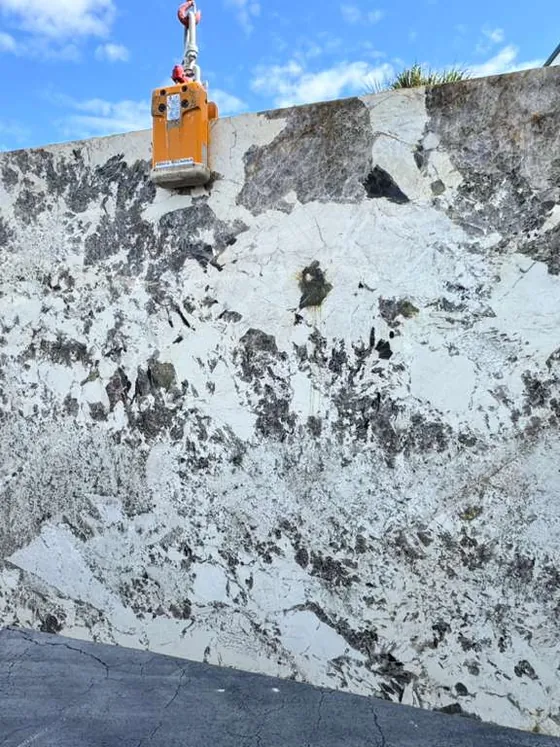
Granite works the other way. Each slab is cut from a natural block, so its crystals, flecks and movement are its own, and two slabs of the same stone can look noticeably different. That is why we suggest choosing the actual granite slab rather than a small sample. You can start with our slabs in stock before you visit.
What Changes the Price
Both materials are priced per square foot. That one figure includes the stone, the templating, the fabrication in our shop and the installation. A few choices move the total:
- The square footage of your runs and island, plus the backsplash height, from a 4-inch strip to the full wall
- Whether your slab comes from our stock, where you pay for the area you use, or is ordered from a supplier, which can mean buying whole slabs
- A 2 cm or 3 cm thickness
- Your edge profile, from the standard straight polished edge to mitered or waterfall ends
- Sink, cooktop and faucet cutouts
- Taking out and hauling away the old countertops, if needed, which your estimate spells out before we start
Slab size matters too. Most slabs come in at about 120 by 55 inches, and a big island or a long run of counter can call for a second slab and a planned seam, whichever material you pick.
We don’t list a price per square foot here, because your layout sets the number. Tell us the shape of the space, even as a phone photo with rough dimensions, and a price comes back for that layout; if you’d rather we measure, that’s free too.
Which One Fits Your Kitchen?
Both quartz and granite are excellent options. The best choice depends on:
- Kitchen style
- Maintenance preference
- Budget
- Color preferences
| Quartz | Granite | |
|---|---|---|
| Made from | Natural quartz and resin | 100% natural stone |
| Sealing | Never | Every 1–2 years |
| Hot pans | Always on a trivet | Handles heat well |
| Spills | Non-porous | Semi-porous, sealed |
| Outdoor kitchens | Not recommended | Recommended |
| Pattern | Repeats slab to slab | Every slab is unique |
Seeing slabs in person is the best way to decide. Pictures online rarely show the true movement and beauty of stone.
Planning more than the countertop? Our kitchen countertops page walks through layouts, islands and waterfall edges.
Visit Our Countertop Showroom
At American Countertops & Design, we have 500+ slabs in stock, including quartz, granite and quartzite. You can walk through our showroom and select the exact slab for your project.
Visit our showroom in Boynton Beach, a minute up the road from Lowe’s. Call (561) 200-5555, or plan your visit and compare slabs at our showroom.