
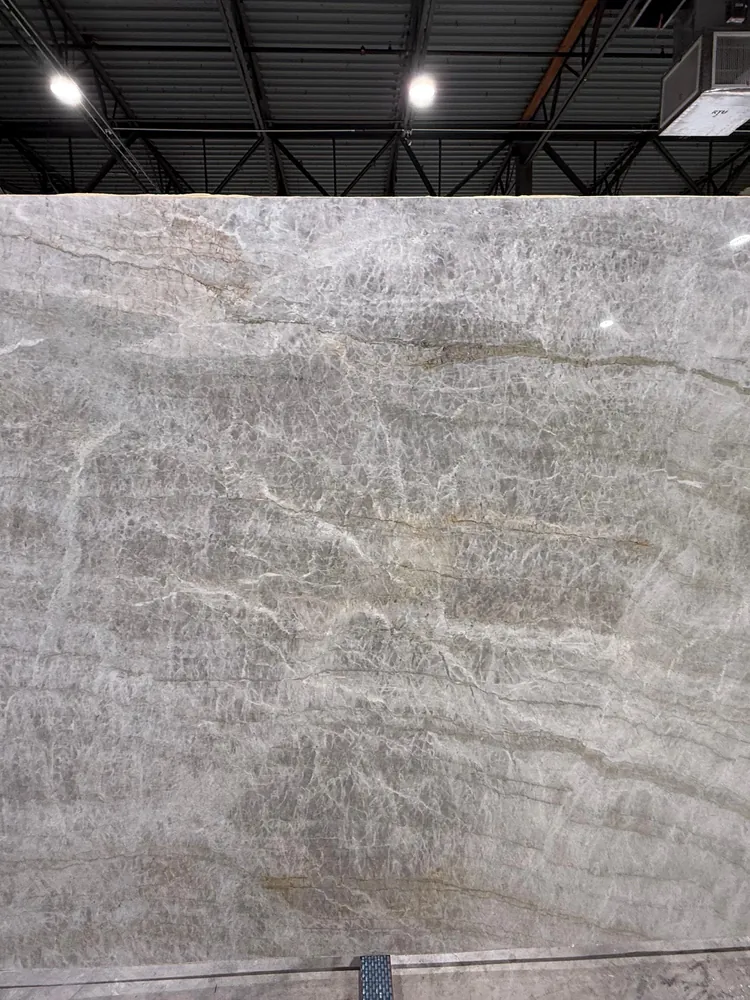
Over the last few years, one stone has become incredibly popular in kitchen remodels.
Taj Mahal quartzite.
Homeowners love it because it offers the natural beauty of marble with the durability of quartzite.
At American Countertops & Design, Taj Mahal is one of the most requested slabs in our showroom.
Below, we look at what makes Taj Mahal quartzite countertops work in a kitchen: how the stone looks, how it holds up and where it fits best. If you're still comparing materials, our overview of quartzite countertops in Boynton Beach covers the stone as a whole.
What Taj Mahal Quartzite Looks Like
Many homeowners love the soft, elegant look of marble. But marble can stain and etch more easily.
Taj Mahal quartzite provides a similar aesthetic:
- Creamy background tones
- Soft natural veining
- Warm color palette
This makes it perfect for modern kitchens, especially when paired with wood cabinets or light flooring.
Because it is natural stone, every Taj Mahal slab carries its own blend of those creamy, warm tones and its own pattern of veins. One tip before you shop: some engineered quartz products borrow the Taj Mahal name, so the name by itself does not tell you what you are looking at. We carry both and we label them apart: four Taj Mahal quartzite slabs and two Taj Mahal quartz slabs. Ask, and we'll tell you which one you are standing in front of.
The Marble Look Without Marble's Weak Spots
So where does the difference come from? Quartzite is a metamorphic stone, and a hard one: harder even than granite. Marble, by contrast, is softer and more absorbent than quartz or granite, so it marks more readily and takes on a patina over time.
| Taj Mahal quartzite | Marble | |
|---|---|---|
| Stone | Natural metamorphic stone | Natural stone |
| Look | Creamy background, soft natural veining | Soft, elegant veining |
| Hardness | Harder than granite | Softer than quartz or granite |
| Stains and etching | Less prone than marble | Can stain and etch more easily |
| Outdoor kitchens | Yes: handles heat and sun | Not recommended |
Marble still has its place, and we recommend it for vanities, feature areas and decorative pieces. If the classic stone is what you have in mind, our marble countertops page explains where it shines.
How Durable Is Taj Mahal Quartzite?
Quartzite is much harder than marble. That means it offers:
- High durability
- Better scratch resistance
- Long-term performance
For homeowners who cook frequently, quartzite is often a safer option than marble.
It also stands up to heat and sun. That is why, along with granite, quartzite is one of the two stones we recommend for outdoor kitchens. As a natural stone, it still needs sealing now and then; more on that below.
Where Taj Mahal Works Best: Islands, Perimeters and Vanities
On kitchen islands, a large, open surface gives the veining room to show. The kitchen pictured above is one of ours: a long island that drops to the floor in a waterfall at each end, with the cooktop cut right into the top. A standard slab comes in at roughly 120 by 55 inches, so an island this long may need a seam; we plan the layout on the actual slab and show you where any seam falls before we cut. Waterfall ends and mitered edges are cut in our own shop, too.
Along the perimeter, where you prep and cook every day, a hard natural stone earns its keep, and a matching backsplash can be cut from it, anywhere from a 4-inch strip to a full-height wall of stone.
It isn't only a kitchen stone, either: Taj Mahal quartzite also makes a striking bathroom vanity top.
Pairing Taj Mahal With Cabinets and Floors
Taj Mahal works especially well in kitchens that aim for a light and airy design.
It pairs beautifully with:
- White cabinets
- Natural wood cabinets
- Neutral backsplashes
- Warm flooring
This versatility is one reason designers love using Taj Mahal.
In the Taj Mahal quartzite kitchen above, the stone sits against white flat-panel cabinets. The surest way to judge a pairing is side by side: bring a cabinet door, a sample of your flooring or a paint chip to our showroom and hold it up to real slabs. The design consultation is free.
Sealing and Everyday Care
Taj Mahal is natural stone, so it needs sealing from time to time. We'll give you a sealing schedule for your particular slab when we install it.
Day-to-day Taj Mahal quartzite care is simple; these habits keep it looking its best:
- Wipe up spills, especially acidic ones like lemon juice, vinegar or wine, instead of letting them sit.
- For routine cleaning, use warm water and a pH-neutral stone cleaner.
- Skip abrasive pads and harsh chemical cleaners.
- Reseal on the schedule we give you.
If you're unsure about a product, call us first.
Seeing Taj Mahal Slabs in Person
Every slab of natural stone is unique.
The best way to choose your countertop is by seeing the slabs yourself.
At American Countertops & Design, we stock hundreds of slabs, and right now four Taj Mahal quartzite slabs are in our inventory: two in 2 cm and two in 3 cm, polished and leathered. Two Taj Mahal quartz slabs are in stock as well, and those are engineered quartz rather than natural stone.
All six are on our slabs in stock page, photographed in September 2026: the quartzite is AC-10 through AC-13, the quartz AC-16 and AC-17. Slabs are sold into projects as the weeks go by, so call with a slab number and we'll confirm it is still available and where you can see it.
Visit our showroom in Boynton Beach, or call (561) 200-5555. We are just 1 minute from Lowe’s. When you're ready, book a showroom visit.